
January
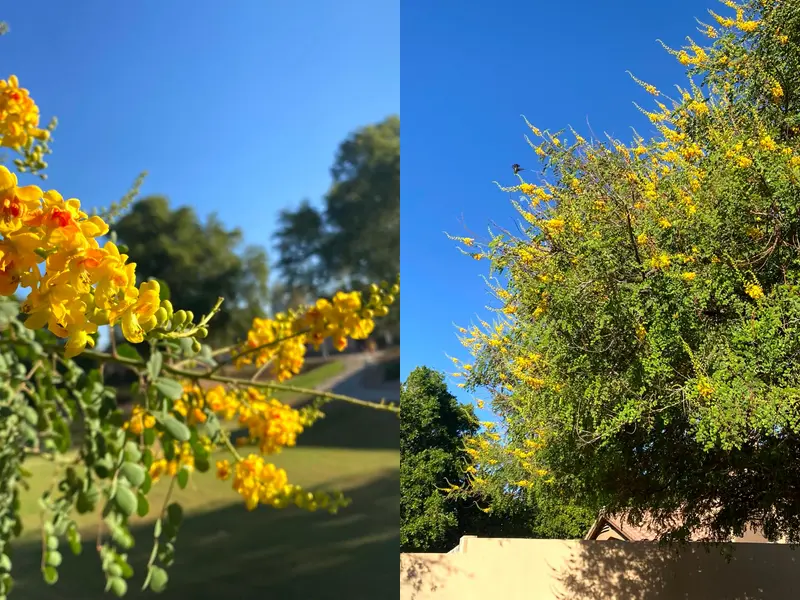
Cascalote
While most trees are going to sleep for winter, this Mexican native is just waking up. From November through February, Cascalote covers itself in tall, arching spikes of lemon-yellow flowers that smell faintly sweet (one of the few flowering trees in the world that peaks in midwinter.) The dramatic curved thorns on its branches are part of its ornamental character; the thorns emerge maroon when young and age to a sculptural gray. It belongs to the same family as the Bird of Paradise and the Palo Verde.
February
Time for romantic walks around the community. These flowering shrubs are sure to make your sweetheart swoon.

Feathery Cassia
This Australian transplant is one of the first plants in the desert to announce that spring is coming (sometimes as early as January.) While most shrubs are still sleeping, Feathery Cassia absolutely covers itself in tiny, butter-yellow flowers with a light, sweet fragrance. Think of it as the desert's version of forsythia, but tougher, requiring almost no water to put on its show.

Valentine Bush
This crimson-flowered Australian shrub earned its common name honestly (it starts blooming right around Valentine's Day), delivering a splash of red when the rest of the landscape is dull and gray. Interestingly, red is one of the rarest colors in the desert winter palette, which is exactly why hummingbirds seek it out obsessively during this time of year.
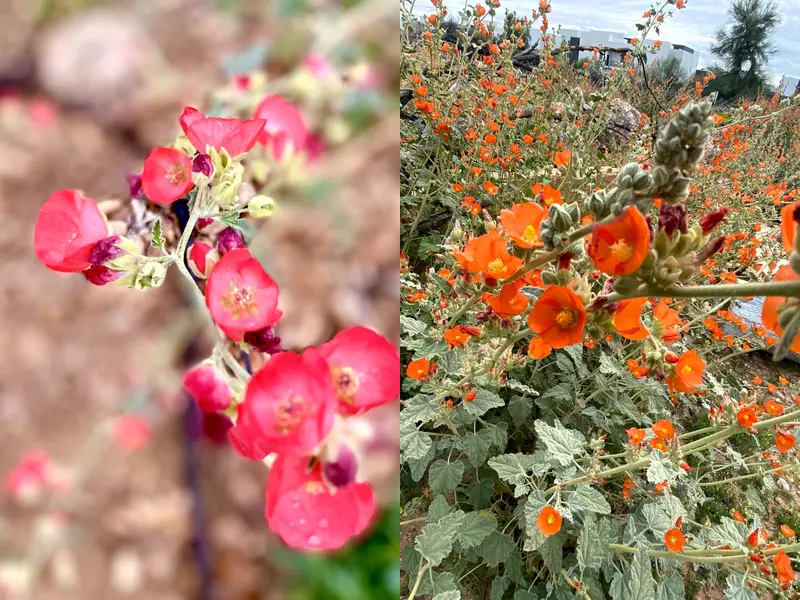
Globemallow
Here's a plant that refuses to commit to a single color. The same species can bloom orange, peach, deep red, pink, lavender, or white (sometimes in the same patch) because seeds from one plant can produce offspring of a completely different hue. Take a walk along our Globemallow path and count the colors.

Texas Mountain Laurel
Close your eyes near this small tree in February and you'll swear someone nearby just cracked open a can of grape soda (that's actually the scent of its deep purple flower clusters.) The blooms don't last long, so catch them while you can.
March
The Tohono O'odham people, who have called this desert home for thousands of years, named the month of March "Uam Masad" (pronounced WAHM MAH-sahd) which meant "the Yellow Time" or "the Yellow Month." Step outside and you'll understand why immediately.

Palo Verde
You're looking at Arizona's official state tree. It also does something almost no other tree on Earth does: its bark photosynthesizes. That brilliant green trunk and branches are packed with chlorophyll, meaning the tree can keep making food even after it drops its leaves during a drought. In March and April it goes nuclear, smothering itself in so many tiny yellow flowers that the whole canopy turns gold. The Tohono O'odham and Pima people ground the seeds into flour for cakes and porridge for thousands of years.
Desert Marigold
This cheerful yellow wildflower blooms almost year-round but peaks in spring. It's one of the most drought-tolerant native wildflowers in North America. If you want to brighten up your yard, feel free to (gently) pull some seed from our neighborhood plants and spread them in your yard.
April

Hesperaloe / Red Yucca
With its tall, arching flower stalks loaded with coral-red tubular blooms this plant is basically a hummingbird's dream come true, designed so precisely for their long beaks that the bird's forehead gets dusted with pollen on every visit. It blooms for months, making it one of the most productive nectar plants in the desert garden.
Fairyduster
The name says it all. This delicate native shrub produces soft, feathery pink-and-white flower puffs that look like something a fairy might actually use for cleaning. It's one of the most reliable hummingbird plants in the Sonoran Desert, blooming heavily in spring and sporadically the rest of the year (and it does all of this on almost no water).
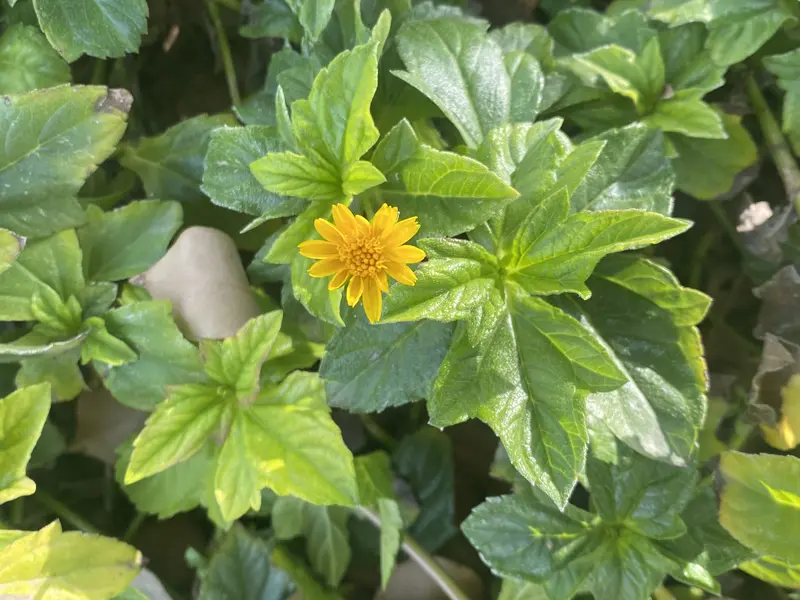
Yellow Dot
A compact, cheerful groundcover that pumps out small yellow daisy-like flowers from spring through fall. It's one of those workhorse plants that never stops blooming, providing a steady carpet of color while requiring almost no maintenance. The tiny flowers are a favorite pit-stop for native bees.

Blackfoot Daisy
Lean in and you might catch a faint vanilla scent from these small white flowers with bright yellow centers. This tough little native wildflower blooms almost continuously from spring through fall, and butterflies can't resist it. The "blackfoot" name comes from the dark, foot-shaped base of each petal (a tiny botanical detail that rewards a close look.)
May

Argentine Giant
This squat, sprawling cactus plays the long game all year; then on one warm night in late spring, it opens flowers the size of a grapefruit. We're talking 8 to 10 inches across, pure white, and powerfully fragrant (like jasmine mixed with citrus). The catch: the flowers open at dusk and are closed again by the next afternoon. The scent is specifically designed to attract hawk moths that pollinate it in the dark. Set an alarm, because missing this bloom would be a genuine shame.
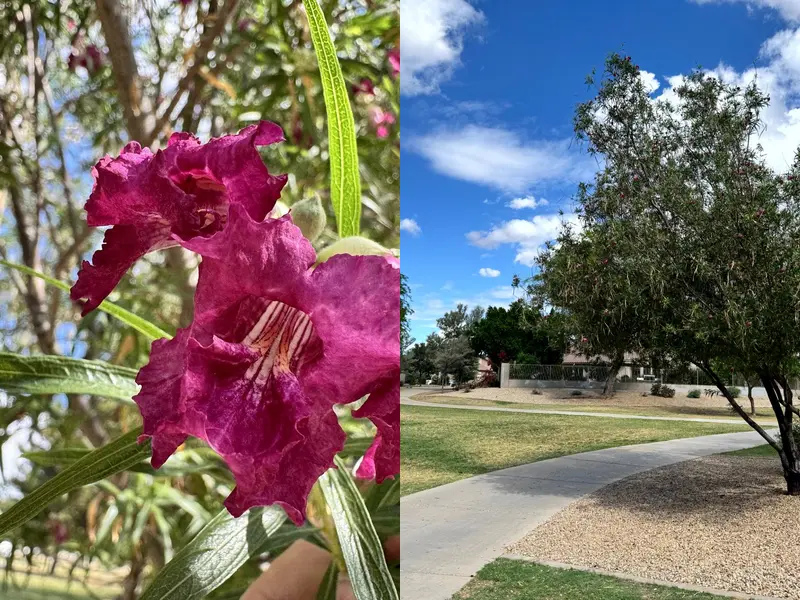
Desert Willow
From May through September it produces ruffled, trumpet-shaped flowers in shades of lavender, pink, and burgundy that smell like a perfume counter on a warm afternoon. Native to desert washes from Texas to California, it's one of the best large flowering trees you can grow in the Southwest.
Chuparosa
"Chuparosa" is Spanish for hummingbird (literally translating to "rose sucker" from chupar (to suck) and rosa (rose)). If Arizona's hummingbirds could vote for a state flower, this would win by a landslide. Its tubular red flowers are engineered so precisely for hummingbird beaks that the bird's head picks up pollen on every sip, making it an involuntary pollinator. So if you want to see hummingbirds, just stand next to this plant. They will likely buzz by asking you to move.

Mexican Honeysuckle
This jungle native from Mexico and Central America brings a tropical burst of orange to shady spots where little else will bloom. Here's the surprising fact: its leaves produce a deep blue-indigo dye when boiled, and women in Mexico and Central America have historically used it as a natural laundry brightener by tossing the leaves in with white linens to keep them brilliantly white. The flowers attract butterflies and hummingbirds year-round.
June
For your plant walks this month please be aware of the high heat once the sun rises. Pack plenty of water and take lots of breaks.

Little Leaf Cordia
A tough Arizona native that produces small beautiful clusters of white flowers throughout the hot summer months, right when most plants are shutting down. Mockingbirds are particularly fond of this plant, using its dense branching as prime nesting territory. It's a quiet, understated plant that rewards those who look closely.

Coral Fountain
This is a plant that looks like it's on fire. Its long, arching stems are covered in tiny scarlet tubular flowers from late spring all the way through fall, creating the impression of a fountain of sparks frozen in mid-air. Despite originating in Mexico, it has absolutely no problem with Arizona heat (in fact, the hotter it gets, the more it blooms.)
July
For your plant walks this month please be aware of the high heat once the sun rises. Pack plenty of water and take lots of breaks.
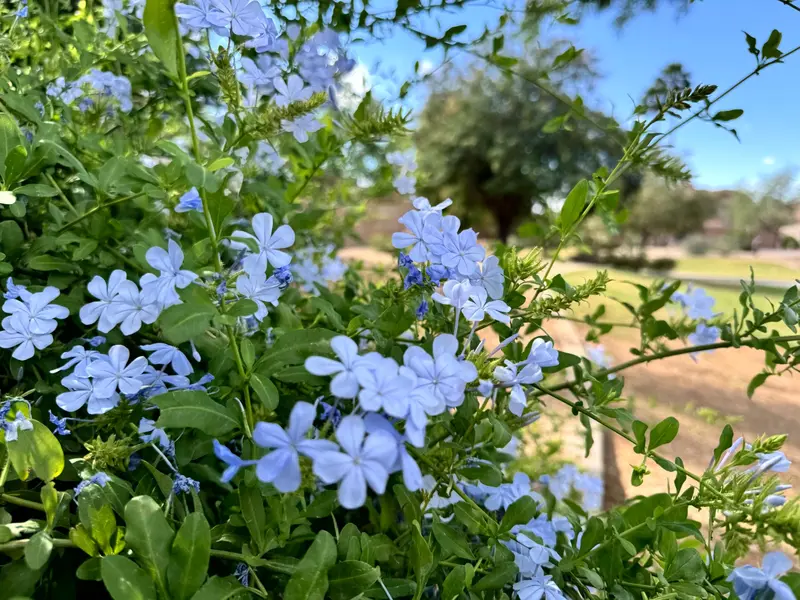
Cape Plumbago
This South African native brings vivid sky-blue flowers to the Arizona garden (a color that's genuinely rare in the desert plant palette.) The blooms are almost constant from spring through fall, and unlike many blue-flowering plants that prefer cool weather, Plumbago actually thrives in the intense Arizona heat. It's a little reminder that the Sonoran Desert and the Karoo Desert of South Africa share surprisingly similar climates.
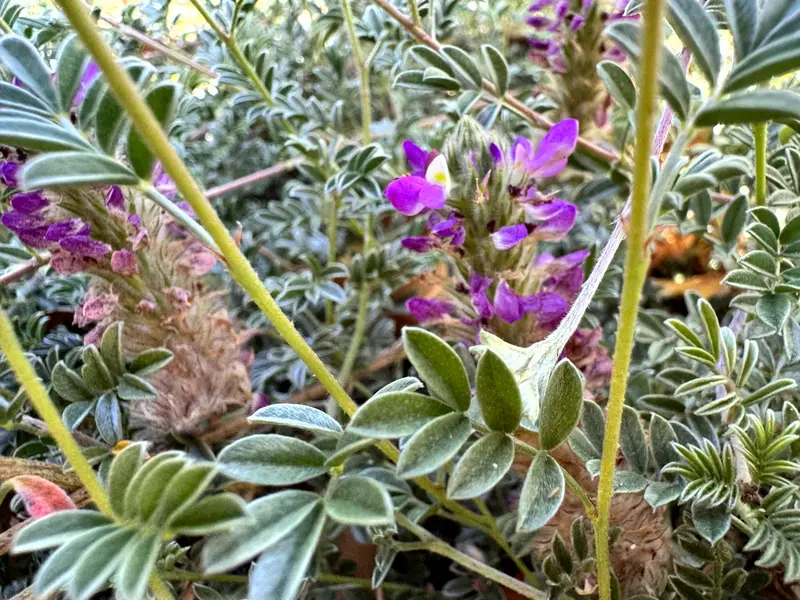
Trailing Dalea
A low-growing native wildflower that spills over rocks and edges with a cascade of small purple blooms in midsummer. Dalea species are some of the best plants for native bees in the Sonoran Desert, supporting dozens of specialist pollinator species. The purple flowers against the silver-gray foliage create a combination that's particularly beautiful in late afternoon light.
Texas Mountain Laurel - Seed Pod Season
The purple flowers are long gone, but now it's time for something arguably cooler: the fuzzy, swollen seed pods. These pods were used by Native American tribes for jewelry and ceremonial rattles for over 6,000 years, and found in archaeological sites across the Southwest. Grab a fallen pod, give it a shake, and hear the seeds rattle (just like they did for cultures that called this desert home long before any of us arrived.)
August
This is Arizona's wettest month. The summer monsoons cool the air, green up the vegetation, and trigger spectacular blooms. Continue to practice heat safety for your plant walks this month with plenty of water and lots of breaks.

Texas Sage - The Barometer Bush
Locals call this the "Barometer Bush" for good reason: when you see it erupt in a cloud of purple blooms on an otherwise calm day, there's a strong chance rain is coming. The plant senses rising humidity and falling barometric pressure (the same conditions that precede a storm) and responds by blooming. It's not perfect meteorology, but it's surprisingly reliable. We leave our bush unsculpted because a naturally shaped plant blooms far more heavily than a sheared one.

Creosote Bush
Take a deep breath after the next summer rain. That clean, sharp, resinous scent that fills the desert air? That's this plant. Creosote is arguably the most important shrub in the Sonoran Desert (and one of the oldest living organisms on the planet.) A creosote "ring" in the Mojave Desert, formed by a single plant slowly cloning itself outward over millennia, has been alive for approximately 11,700 years. The tiny waxy leaves release that iconic fragrance when wet as a survival mechanism (and for many Arizona residents) it's the smell of home. If you want to catch that rain smell any time, rub the leaves in your hands and take a deep breath.
September

Goldeneye
A native Arizona wildflower that kicks into high gear after the summer monsoons, painting roadsides and desert hillsides in bright yellow from late summer through fall. Named for its distinctive golden-yellow ray flowers with a darker eye at the center. It's one of the most important late-season nectar sources for monarch butterflies as they move through Arizona on migration.
Bird of Paradise
This bold, architectural plant lights up September with clusters of flamboyant red-and-orange flowers with long red stamens that stick out like fireworks. It looks like something out of a tropical garden, not a desert. Despite the exotic appearance, it's extremely tough and drought-tolerant. The Mexican Bird of Paradise blooms nearly year-round and is one of the most hummingbird-friendly plants you can put in an Arizona yard.
October
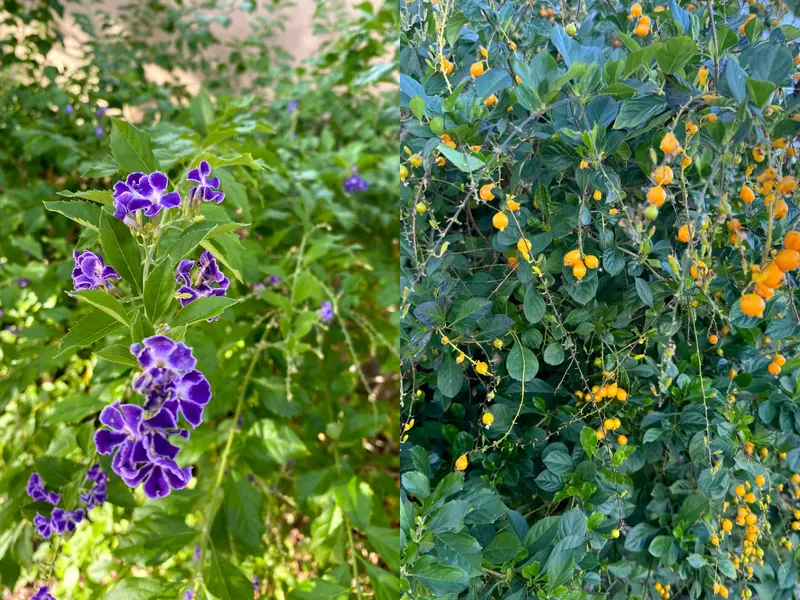
Skyflower / Golden Dewdrop
Originally from Brazil, this fast-growing shrub puts on two different shows in the same season: delicate purple flowers followed by clusters of small golden berries that give it another common name, "Golden Dewdrop."
Hopbush
Look carefully at the female Hopbush this month and you'll find one of the desert's most elegant seed pods: papery, three-winged capsules that emerge green, turn pink and deep red, then age to a parchment tan. They look like little butterflies. When they drop and catch the breeze, they spiral to the ground like tiny helicopters. The name comes from Australia, where early settlers used the dried seed pods as a substitute for hops in beer brewing. This particular plant is native to Arizona (and one of only a tiny handful of plants shared between the Sonoran Desert and Australia.)
November

Regal Mist Grass
The flowers of this plant, called inflorescences, are so fine and numerous that from a distance the whole plant appears to float in a cloud of soft pink. The magic window for viewing it is early morning or late evening, when low-angle sunlight hits the seed heads and they glow like a pink fog. A walk through our greenspace at golden hour in November is worth setting your alarm for.
Bush Dalea
A native Sonoran Desert shrub that puts on a final purple show in late fall, just when you think the bloom season is winding down. Bush Dalea is a keystone plant for native bees, supporting dozens of specialist pollinator species that depend on it almost exclusively. Its silvery foliage glows year-round, making it handsome even when not in bloom.

Desert Milkweed
This plant blooms year-round, but November is the month to look very carefully at it. Queen butterflies and Monarch butterflies use it as a nursery, laying tiny eggs on the stems that hatch into the distinctive black, white, and yellow banded caterpillars. Here's a remarkable fact about those caterpillars: as they eat the milkweed, they absorb its toxic compounds into their own bodies, making themselves poisonous to birds; a chemical armor they carry for the rest of their lives. Look gently for the caterpillars, but please don't disturb them.
Cascalote
While most trees are going to sleep for winter, this Mexican native is just waking up. From November through February, Cascalote covers itself in tall, arching spikes of lemon-yellow flowers that smell faintly sweet (one of the few flowering trees in the world that peaks in midwinter.)
December
While the rest of the world celebrates Fall color in October, our fall starts in late December (one of the desert's best-kept secrets.) Take a walk through our greenspaces to catch it while it lasts. These are wonderful spots for family photos, or simply a quiet stroll with a cup of cider. No flight to Vermont required.
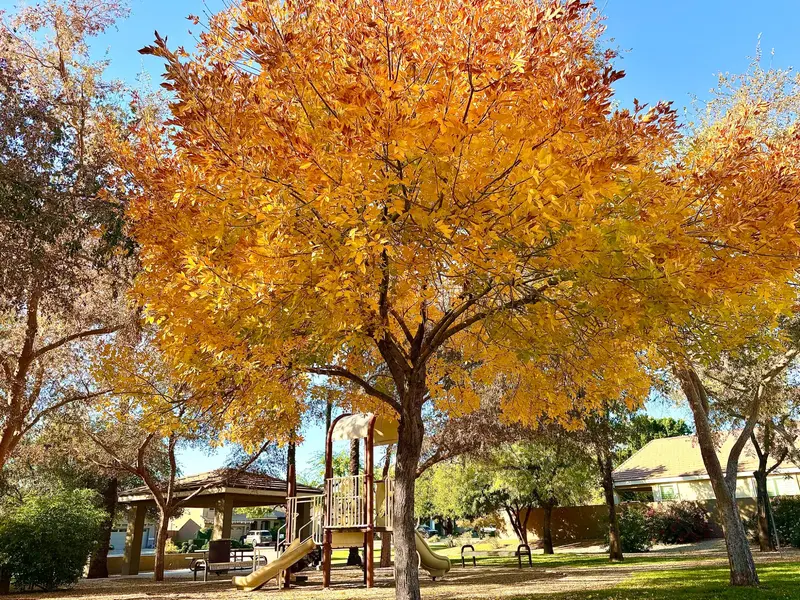
Ash Tree
Ash trees turn a warm, buttery gold in late fall (a softer, gentler complement to the fiery reds elsewhere in the community.) Their winged seeds, called "keys" or "samaras," spin like helicopter rotors when they fall (irresistible to kids (and adults) who want to toss them in the air and watch them spiral down.)
Chinese Elm
One of the best fall-color trees for the desert Southwest, the Chinese Elm turns rich yellow and gold in December (later than most other deciduous trees), extending the color show well into the new year. Its bark develops an attractive mottled, peeling pattern as it matures, providing year-round interest.

Chinese Pistache
The showstopper of our December color walk. The Chinese Pistache is a close relative of the pistachio nut tree, but this ornamental version trades edible nuts for spectacular fall color (the same tree that provides dense shade all summer long transforms into a column of scarlet, orange, and gold in December.) It is one of the last trees in the landscape to color, which means it extends our fall season well past when most other trees have gone bare.